Small teams, loosely joined
May 7th, 2010
This is re-posted from the News Apps Blog.
Last week, we launched a new application for the RedEye – the Chicago homicide tracker. The web site makes it simple and interesting to browse homicide crime data for the city. RedEye reporter Tracy Swartz has been compiling the homicides since Jan. 1, 2009 and writes a weekly analysis. She wanted to give readers a better way to browse and understand the data and we wanted to help but never had enough time to give the project the attention it deserved.
The homicide tracker might look familiar if you’ve ever seen the L.A. Times homicide project. That’s because it’s the same code. LA Times hacker team of Ben Welsh and Ken Schwencke generously let us use their code (caveat: we all get our paychecks from the same place – Tribune Co.). It took four days of re-factoring, reorganizing, writing new data loaders and a new skin to make the L.A. Times code work for the RedEye.
This kind of project plays to the strength of the small newsroom dev team. We started with a small-medium application that was built to solve a specific problem, but not to be reusable. We worked with the reporters to figure out what about the L.A. Times app we should keep, what we should scrap and what we should change. We ignored the urge to refactor and leave as much of the original code as possible, tweaking only what was necessary. With the help of the author of the original, we were able to quickly make our changes and launch.
Free and open technologies are key to our small teams working quickly. Pulling content and data from RSS and Google spreadsheets allowed us to skip building a content management system for the homicide tracker. Using a sophisticated, modular web framework helps to make us efficient.
The moral of the story is that for news apps, small teams sharing code, insight and ideas – “small pieces, loosely joined” – is quite effective.
django + facebook connect
April 2nd, 2009While working on News Mixer and another django project, I’ve refactored all the facebook connect code Brian Boyer and I wrote into a separate application. I’ve opened a google code page for it. I figured if it’s useful to me, it would be useful to others.
It’s a simple thing really. It uses the built in django auth stuff and pyfacebook, and works with django-registration. News Mixer was designed so you had to use facebook and only facebook to log in. The django-facebookconnect application can work side-by-side with regular django user accounts, and it gives new facebook users the option to link their django and facebook accounts.
While building News Mixer, we had a lot of problems getting facebook connect to play nice. Timeouts, expired sessions and connection resets would quickly kill our application. On the face of it, the app doesn’t really do a whole lot, but under the hood it deals with a ton of BS problems that you run into using the facebook API extensively.
Take it, use it, let me know how it goes.
Whats next for News Mixer
March 11th, 2009The initial release of News Mixer was the result of eleven weeks of intensive research and development by graduate students at Northwestern University’s Medill school of journalism and sponsorship from the Cedar Rapids Gazette. The goal of the first release was to demonstrate different ways of thinking about how foster communities and conversations around news articles on the web, and not to build a real news website or software to power a real news website.
Version 1.0 of News Mixer is a standalone application built on Python and Django. It is meant as a technology demo. For those who liked the ideas and wanted the software, News Mixer is a great commenting system, but it lacks depth. There was very little time put into anything but the commenting. The content management component is minimal. There is no support for posting media. There was a lot of thought but little dev time put into comment moderation, either for site owners or visitors. It’s what happens when you only have 11 weeks to go from “you can do whatever you want” to working software + report + polished presentation.
Despite the minimalism of News Mixer 1.0, it was a hit. People were impressed and inspired by it. So for a tech demo it was a success. Now to make it usable …
Usefulness
Yes, there will be a Wordpress plugin.
The next release of News Mixer will be a more useful application built to actually be used by folks. The plan is to build an API on top of News Mixer and build a plug-in to make the features available for Wordpress. In addition to an API, we’re going to give News Mixer the ability to handle commenting for multiple sites.
Why not just put all the commenting features into a standalone Wordpress plug in?
So the wheel re-invention is kept to a minimum. So we can plug the features into other applications without writing everything from scratch. So folks can manage the comments for many sites in one place. And so maybe it will grow up to be its own web service someday.
There is a big list of things that our team came up with that could make News Mixer better: more commenting systems, rating systems, moderation. But right now we need to make it accessible for people to use.
UPDATE:
Keep tabs on us at the News Mixer Google Code Project.
UPDATE 2:
This project has been dead for a while. Sorry for the disappointment.
Andy Dickinson built a plugin for Wordpress called Feedback by Paragraph that accomplishes much of the paragraph commenting that was implemented in News Mixer.
Thoughts on India
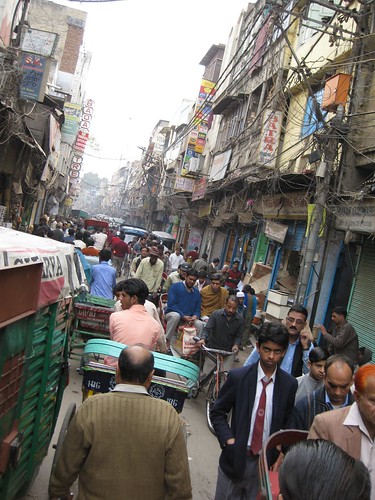
February 24th, 2009So many colors. That’s what every traveler says at some point on their way through India. Festivals, saris, semi-trucks: everything is vibrant, over-the-top, baroque. The visual complexity of India is just the surface.
I returned to Chicago on February 10 after two eight hour flights and five hour layover at Heathrow in London (least they had beer). Man jet lag is a bitch. I managed to stay awake through most of the traveling in the hope that once I got home and passed out, I would wake up the next morning at my usual time and feel all adjusted.
Wrong.
I woke up at five the next morning ready for a dinner. Wide awake, body not caring that it was still dark out and there was no curry to be found. Two weeks later and my internal clock is finally adjusted.
I’ve been telling my stories and trying to explain India to everyone who’s interested.
India is a wonderful, fascinating place. And it’s absolutely insane. Not in a deranged way, like I said, It’s a wonderful place.
Some knee-jerk examinations:
1. There are so many people in India. And they all hang out on the street. At least all the men do. I don’t know where the women hang out, just not all on the street. A country of over one billion in the space one-third the size of the entire United States.
2. There are two India’s. And they exist on top of one another. The prosperous, westernizing/modernizing, middle-upper class India that I recognize having grown up in the middle class neighborhoods of the United States, and poor India. In America we push the poor, unsightly, unappealing to the fringes of society. The streets are clean and empty. In India the poor, unsightly, unappealing is in your face. The problems of the poor are tied to India’s future. And the current government has recognized that and has put an effort into improving infrastructure, health care and education for the poor.
3. Most rules are optional in India. If the rule is unnecessary or in your way, especially if you are in some kind of motorized vehicle with a horn, forget the rule and honk.
I like it.
Why is it that Americans wait for the red lights to change when there is no traffic going the other way? Because of the camera at the stop light. Or because there just might be a cop lingering in that dark parking lot. Our safety-obsessed, sue-happy culture has reduced deaths on the road and accidents in the workplace. Waiting for a few minutes at a stop light never hurt anyone, but our society invests so much into our system of rules those rules are just not questioned. Do we need to law-ify every single nugget of common sense in order to get people to not do dumb stuff?
4. All Indians know one another. Not really. But it seems that way when you don’t understand Hindi. Indians make fast friends. Especially in the country, but even in the city, the social aspect of Indian life is much more open and important than anywhere I’ve been. And if someone knows a little English, you will hear it. Some will strike up a conversation and eventually try to sell you something, but just as many just want to ask you where you’re from.
It’s an amazing place and I encourage everyone to go there. Make sure you learn to like Indian food first, and don’t just eat curry when you’re there. It’s not that good for you.
Madhya Pradesh
January 23rd, 2009Tonight the group leaves for Delhi after traveling through the towns and cities of Madhaya Pradesh. It was great country, friendly people, and only a small bit of the hustle and crush of Mumbai. We saw buddhist and hindu caves, hills carved into forts and magnificent palaces.
We stayed in some beautiful places, off the beaten tourist track and got to relax. Traveling with a guide makes for a relaxing trip – having somebody who can translate and make the plans takes a load off your back. But I am happy it is finished. Relying on somebody and traveling with like minded tourists is quite insulating.
I’m looking forward to Delhi and meeting some friends in a few days. There are new photos up and more to come.